
Welcome to the final part of our local SEO series. In our Google Business Profile optimization guide, we covered the foundation of local search visibility. In our website optimization and local citations guide, we tackled on-page SEO and citation building. Now we’re covering local link building for Halton Region businesses, plus the content marketing that supports it: the advanced strategies that transform page 2 businesses into local pack dominators.
Advanced local SEO combines strategic link building from local organizations, regular content creation targeting long-tail local keywords and consistent execution over 6 – 12 months. These tactics separate businesses ranking #1 from those stuck on page 2.
Local Link Building in 2026: What Actually Works
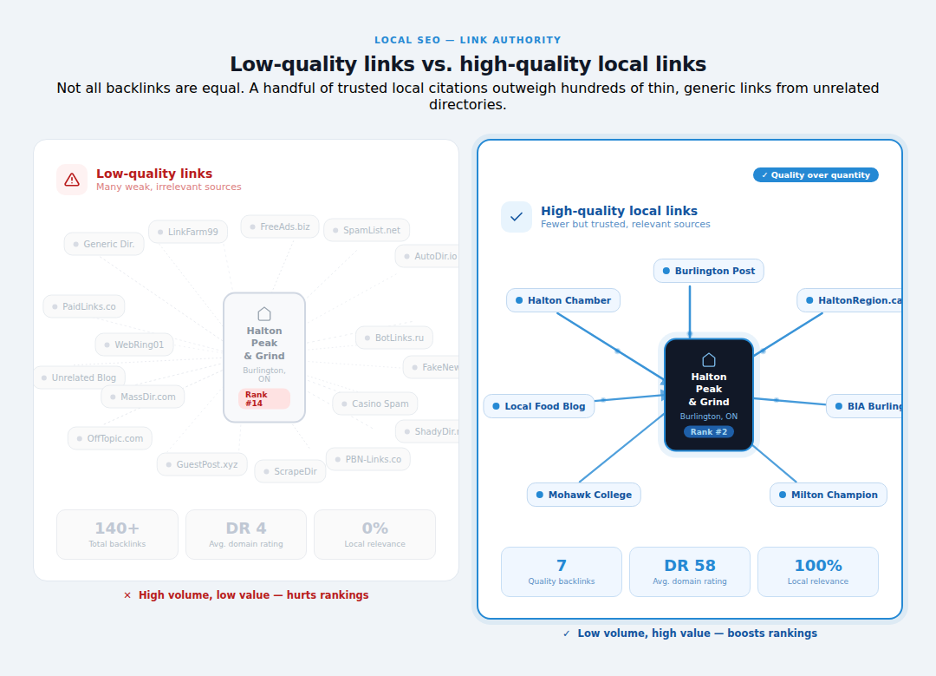
Backlinks remain one of Google’s top ranking factors. For Halton Region businesses, local link building carries extra weight because each link signals both authority and geographic relevance. A single link from the Burlington Chamber of Commerce does more for your local rankings than ten links from generic directories.
How Many Backlinks Do I Need to Rank Locally?
Quality matters more than quantity. Most local pack winners have 15–30 high-quality backlinks from local sources. One link from a Chamber of Commerce outweighs ten links from low-quality directories.
Link value hierarchy for local SEO:
Link Source | Value | Difficulty | Example |
|---|---|---|---|
Local news sites | Very High | Hard | Burlington Post feature |
Chambers of Commerce | High | Easy | Member directory listing |
Local .edu sites | Very High | Medium | Mohawk College partnership |
Event sponsorships | High | Medium | Sound of Music Festival |
Local business partners | Medium | Easy | Complementary business |
Industry directories | Medium | Easy | Houzz, Avvo profiles |
Halton-Specific Link Building Opportunities
Local link building in Halton Region doesn’t require a big budget, it requires relationships. Here are the most accessible opportunities:
Event sponsorships: Sponsor Burlington Sound of Music Festival, Oakville Midnight Madness, or Milton Fall Fair for website recognition links.
Business partnerships: Team with complementary local businesses for content collaboration and cross-linking.
Local media: Pitch newsworthy stories to Burlington Post, Oakville Beaver, or Milton Champion.
Associations: Join Burlington Chamber, Oakville Chamber, Milton Chamber, or Mississauga Board of Trade for member directory links.
Guest posts: Write for local business blogs and community websites with author bio links.
Paid Links vs Earned Links: What’s the Difference?
Earned links come from valuable content or relationships, which Google rewards. Paid links are purchased primarily for SEO value and can lead to penalties. Sponsorships are paid but legitimate when they provide real value beyond the link.
Legitimate paid links (allowed):
- Event sponsorships with website recognition
- Chamber of Commerce memberships
- Charitable donations with donor recognition
- Industry association memberships
Link schemes (penalized):
- Buying links from link brokers
- PBN (Private Blog Network) links
- Mass directory submission services
- Links from unrelated foreign websites
- Reciprocal link exchanges at scale
Content Marketing for Local SEO in 2026
Local SEO content marketing for Ontario small businesses is one of the highest-ROI activities you can invest in. Blogging helps you rank for long-tail local keywords your competitors overlook. While your homepage targets “Burlington web design,” blog posts capture searches like “how much does a website cost for a small business in Ontario” or “do I need a separate website for my Oakville location.”
At Design Evolution, our blog drives most of the local traffic by targeting informational searches from business owners early in their buying journey.
How Often Should I Blog for Local SEO?
One well-optimized blog post per month is enough for most local businesses. Consistency matters more than frequency. Publishing monthly for 12 months outperforms publishing weekly for 3 months and then stopping.
Content frequency vs results:
- 1 post/month = Solid results (recommended for small businesses)
- 2 posts/month = Excellent results (ideal if you have resources)
- 4+ posts/month = Diminishing returns (better to invest in link building)
Best Blog Topics for Halton Region Businesses
Service guides: “Complete Guide to Website Design for Burlington Small Businesses” or “How to Choose a Web Designer in Oakville: 7 Questions to Ask”
Local events: “Burlington Chamber Business Expo Highlights” or “Oakville Midnight Madness 2026 Recap”
Industry content: “Web Design for Burlington Restaurants” or “Local SEO for Halton Contractors”
Comparisons: “DIY Website vs Professional Designer: Cost Breakdown” or “Local SEO vs Google Ads: Where Should a Halton Business Spend First?”
Blog Post vs Google Post: What’s the Difference?
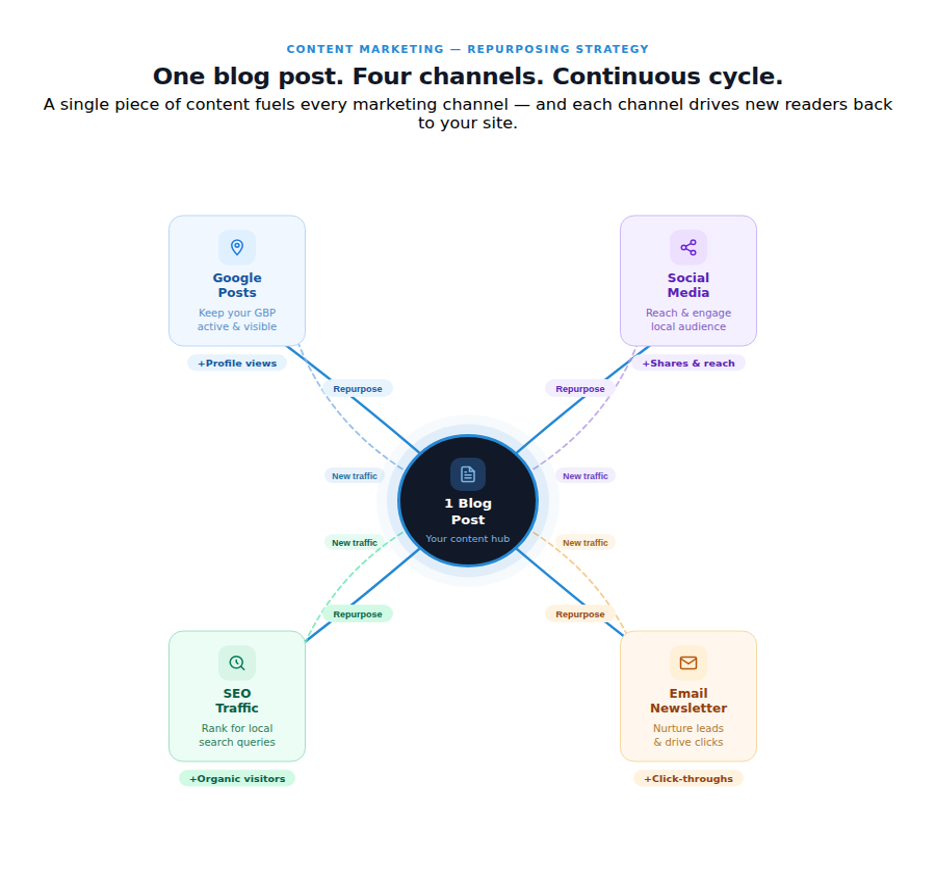
Blog posts are permanent website content that ranks in Google search. Google Posts are temporary updates on your Business Profile that appear in local results but expire after 7 days. Use both together.
Strategic combination:
- Write one blog post monthly targeting “[Service] + [City]”
- Create 4 Google Posts throughout the month highlighting different sections
- Share on social media
- Email to your list
Repurpose one piece of content across four channels.
How to Track Local SEO Results in 2026
What Metrics Should I Track for Local SEO?
The four critical metrics are: Google Business Profile views (visibility), Google Business Profile actions (calls, directions, website clicks), local keyword rankings (Google Search Console), and organic traffic from your region (Google Analytics with location filters).
Weekly monitoring:
- Google Business Profile views and actions
- New review count and average rating
- Response rate to reviews
Monthly monitoring:
- Rankings for 5 – 10 target local keywords
- Organic traffic from Halton Region
- Conversion rate (form submissions, calls)
- Citation consistency scores
Quarterly monitoring:
- Backlink profile growth
- Competitor comparison
- Content performance analysis
Free Local SEO Tools Every Business Should Use
Essential tools: Google Search Console (keyword tracking), Google Analytics 4 (traffic analysis), Google Business Profile Insights (local visibility), Mobile-Friendly Test (mobile optimization), Rich Results Test (schema validation).
Helpful extensions: MozBar (domain authority), Detailed SEO Extension (on-page analysis), Redirect Path (redirect issues).
How Long Does Local SEO Take to Work? (Realistic Timeline)
Basic Google Business Profile optimization shows results in 2 – 8 weeks. Full local SEO implementation (citations, content, and links) typically takes 3 – 6 months for consistent local pack appearances. Top 3 positions for competitive keywords require 6 – 12 months of sustained effort.
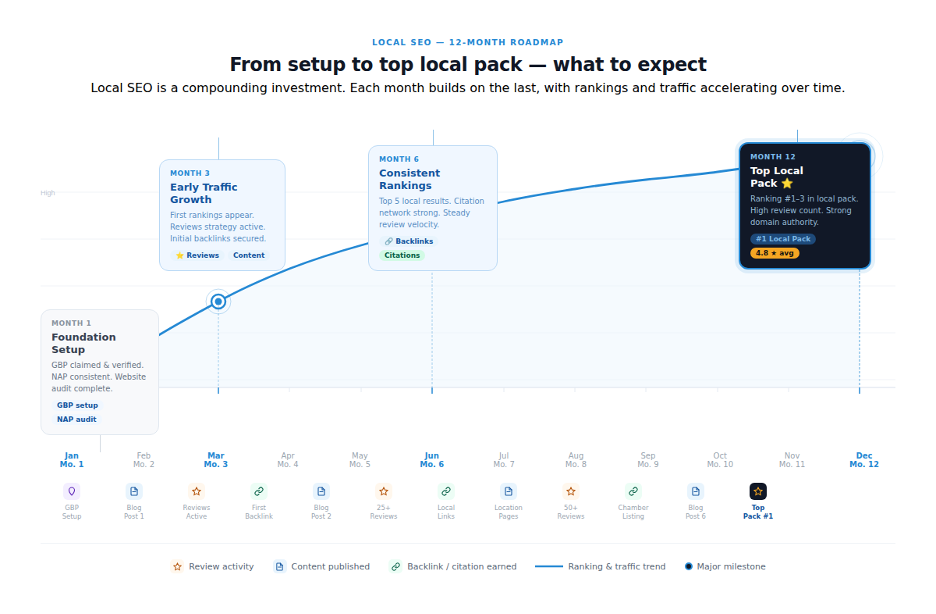
Month-by-month expectations:
Month 1: GBP optimization complete, website updates live, initial citation building
- Results: Increased Business Profile views, occasional local pack appearances
Month 2: First blog posts published, review requests sent, citations building
- Results: More consistent map appearances, traffic increasing 15 – 25%
Month 3: Link building underway, content library growing, reviews accumulating
- Results: Local pack appearances for less competitive keywords, traffic up 30–40%
Month 4 – 6: Ongoing content, consistent reviews, link relationships established
- Results: Consistent local pack rankings, traffic up 50–75%, leads increasing
Month 6 – 12: Authority building, competitive keyword targeting, content expansion
- Results: Top 3 local pack positions, traffic doubled, dominant local presence
Common Local SEO Mistakes Halton Businesses Make in 2026
Avoid these costly errors: ignoring Google Business Profile, inconsistent NAP across platforms, missing location keywords in content, targeting Toronto instead of dominating Halton first, poor mobile experience, not asking for reviews, building spammy links and duplicating content across location pages.
Your Complete 30-Day Local SEO Action Plan
Week 1: Foundation (Google Business Profile)
- Claim/verify Google Business Profile
- Choose specific primary category
- Write 500-word keyword-rich description
- Add 3 – 5 service areas
- Upload 15+ photos (exterior, interior, team, work)
- Verify hours including holiday schedules
- Add all services with descriptions
Week 2: Citations & Consistency
- Create NAP format document
- Claim Yelp Canada listing
- Claim Yellow Pages Canada listing
- Claim Better Business Bureau listing
- Join local Chamber of Commerce
- Audit existing citations for inconsistencies
- Update website NAP to match standard format
Week 3: Reviews & Engagement
- Get direct Google review link
- Create review request email template
- Email 10 recent satisfied customers
- Respond to all existing reviews
- Set up weekly review monitoring reminder
- Create QR code for in-person review requests
Week 4: Content & Optimization
- Write first local blog post (“[Service] in [City]”)
- Optimize homepage title tag and meta description
- Create first Google Post linking to blog
- Share blog on social media
- Set up Google Search Console
- Set up Google Analytics location tracking
- Plan next 3 months of content topics
What Happens After 30 Days?
Continue with weekly Google Posts, monthly blog content, and ongoing review requests. Track your Google Business Profile insights and website analytics monthly.
Local SEO is a long-term strategy. Competitors who’ve been optimizing for years have a head start but consistent execution closes that gap within 6 – 12 months. At Design Evolution, our free website audit covers your Google Business Profile, on-page optimization, citation profile and delivers a customized roadmap for dominating local search in your Region. Request your free audit.
You now have the complete playbook. The businesses ranking highest aren’t the best, they’re just the most consistent.
Start today. Your competitors probably won’t.
Revisit our Google Business Profile optimization guide for Part 1 and our website optimization and local citations guide for Part 2.