
The question is everywhere in 2026: will AI replace Google search entirely? If you run a small business in Halton Region, Toronto, GTA and Hamilton, you’ve been watching the conversation unfold and may notice two camps. One group insists that ChatGPT and Perplexity are about to bulldoze Google’s search monopoly overnight. The other says nothing is changing and you should ignore AI search entirely. Neither position is quite right and neither one helps you make good decisions with a limited marketing budget.
What follows is a grounded, practical look at where things actually stand, what Canadian small business owners should prioritize right now and how to build visibility in both channels without doubling your workload or your spend.
Where AI Search Actually Stands in 2026
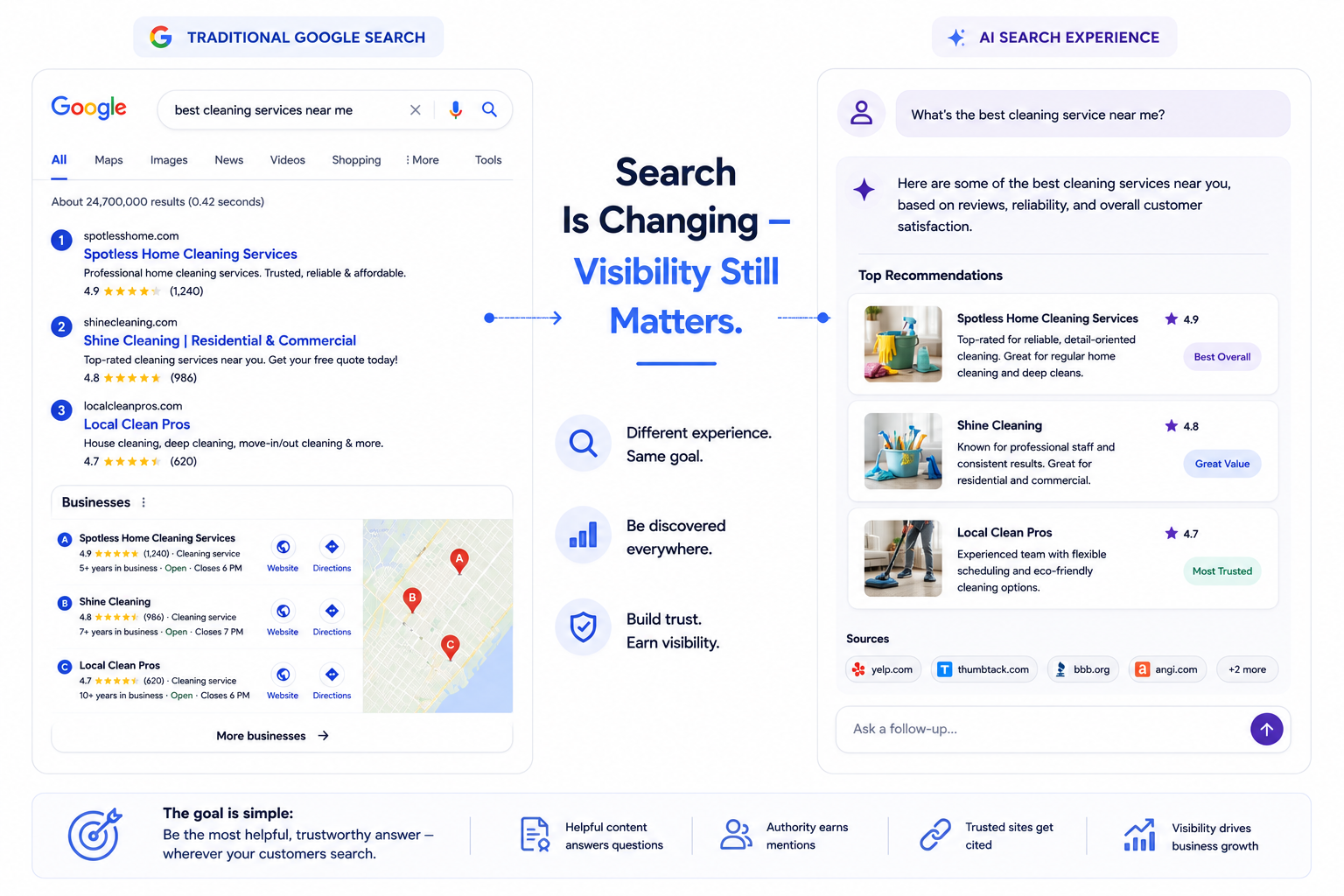
AI-powered search tools have moved from novelty to genuine utility surprisingly quickly. The AI-powered search alternatives gaining real traction in 2026 are Perplexity, ChatGPT Search, and Claude, and all three now field serious query volume. Microsoft’s Copilot is baked into Windows and Microsoft 365, which means a large slice of Canadian office workers encounter AI-generated answers before they ever open a browser tab.
But Google still processes the overwhelming majority of search queries worldwide, and that share has not collapsed the way some commentators predicted it would by now. Google’s own AI Overviews feature, which surfaces synthesized answers directly in search results, is itself an AI search product. Google has not been sitting still.
The disruption is real in the sense that consumer behaviour is gradually shifting. For certain query types, particularly research-heavy or comparison-style questions, a meaningful and growing number of users are turning to AI tools first. For local searches, transactional queries, and quick lookups, Google remains the dominant reflex. The shift is real, it is happening, and it is gradual. That combination is actually good news for small businesses, because gradual change is actionable change.
How Canadian Small Businesses Are Actually Using AI Search Right Now: Adoption Data That Changes Your Strategy
Canadian consumers have adopted AI tools at a pace broadly consistent with global trends, but with some distinct characteristics. Urban centres like Toronto, Vancouver, Calgary, and Montreal show higher AI tool usage, particularly among younger professionals and knowledge workers. Rural and suburban adoption lags, which matters if your customer base skews outside major metro areas.
The query types driving Canadian AI search adoption are telling: product research, service comparisons, how-to questions and health-related queries top the list. These are exactly the kinds of informational searches where a well-structured, authoritative website can earn citations inside AI-generated answers. They are also queries where Google has historically rewarded quality content.
For small businesses selling locally, the practical implication is this: most of your customers are still finding you through Google Maps, Google Search, or word-of-mouth referrals. AI search is a growing secondary channel, particularly for customers in the research phase of a purchase decision. That framing should guide where you put your energy. The research about Canadians adopting AI in daily business operations can be found here.
AI Search or Not, SEO Fundamentals Still Deserve a Canadian Small Business Budget
Google continues to invest heavily in its search infrastructure, its AI capabilities and its advertising ecosystem. The company has every incentive to integrate AI natively into search and they have been on a mission to accomplish that. This does not signal the end of SEO; it signals an evolution in what good SEO looks like.
The fundamentals that made websites rank well in 2024 are still the fundamentals that matter in 2026: clear site architecture, fast load times, mobile optimisation, authoritative & well-structured content and a credible backlink profile. If anything, the rize of AI Overviews has made some of these factors more consequential. Google’s AI systems need to trust a source before they pull from it. That trust is built through the same signals SEO practitioners have always worked to establish.
Abandoning SEO spend to chase AI search visibility would be a costly mistake for most Canadian small businesses right now. The ROI on traditional SEO, particularly local SEO, remains strong and measurable. A Google Business Profile that is properly maintained, with current hours, photos, and consistent reviews still drives foot traffic and phone calls in a way that no AI answer box replicates.
Keep the SEO fundamentals funded. Build on them. Do not sacrifice them. More details about this on our local seo part 1, part 2 & part 3 blogs.
The ‘Both/And’ Playbook: How to Maintain Google Visibility While Building AI Search Presence Simultaneously
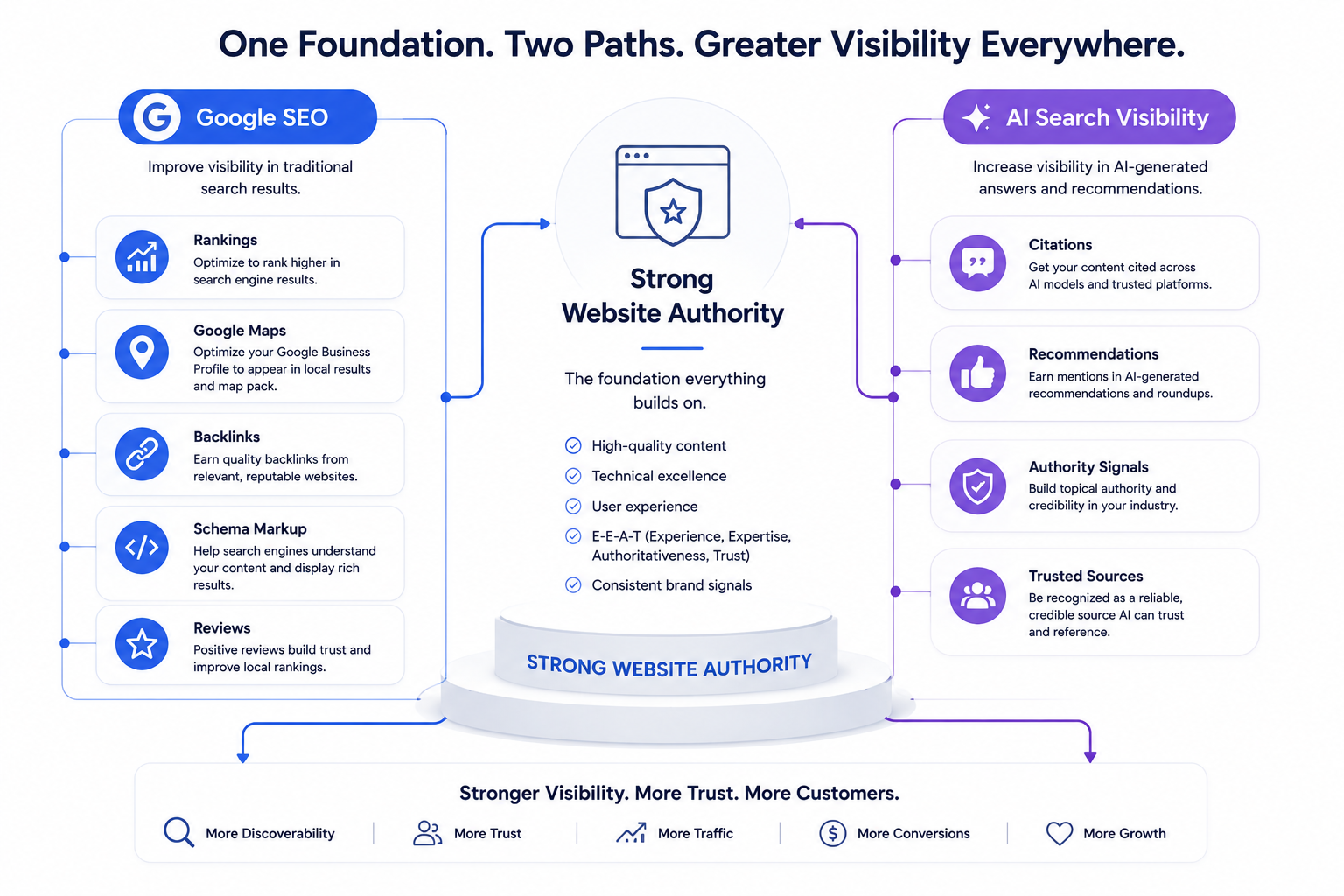
The good news is that the skills and assets required for strong Google SEO overlap significantly with what AI search platforms need to cite your business. This is not a case where you need two entirely separate content strategies.
Well-structured, clearly written content is what both Google’s crawlers and AI language models draw from. A page that answers a specific question thoroughly, cites its sources or reasoning, and is organized with descriptive headings will perform across both channels. The difference lies in a few key areas.
For Google: you are still optimizing for rankings, click-through rates, and local signals. Backlinks matter. Schema markup matters. Page speed matters.
For AI platforms: you are optimizing to become a cited source. This means your content needs to be direct and quotable. AI tools tend to pull from pages that state a clear position or provide a specific fact rather than hedging everything. Authority signals matter here too, but they manifest differently: being mentioned on credible third-party sites, having consistent business information across directories and producing content that other sites link to as a reference.
The practical overlap means that an investment in quality content benefits both channels. A well-researched service page or blog post that earns a Google ranking today is the same asset that can earn a citation in a Perplexity answer tomorrow.
Platform-Specific Tactics: How to Get Your Business Featured in Perplexity, ChatGPT, and Claude Answers
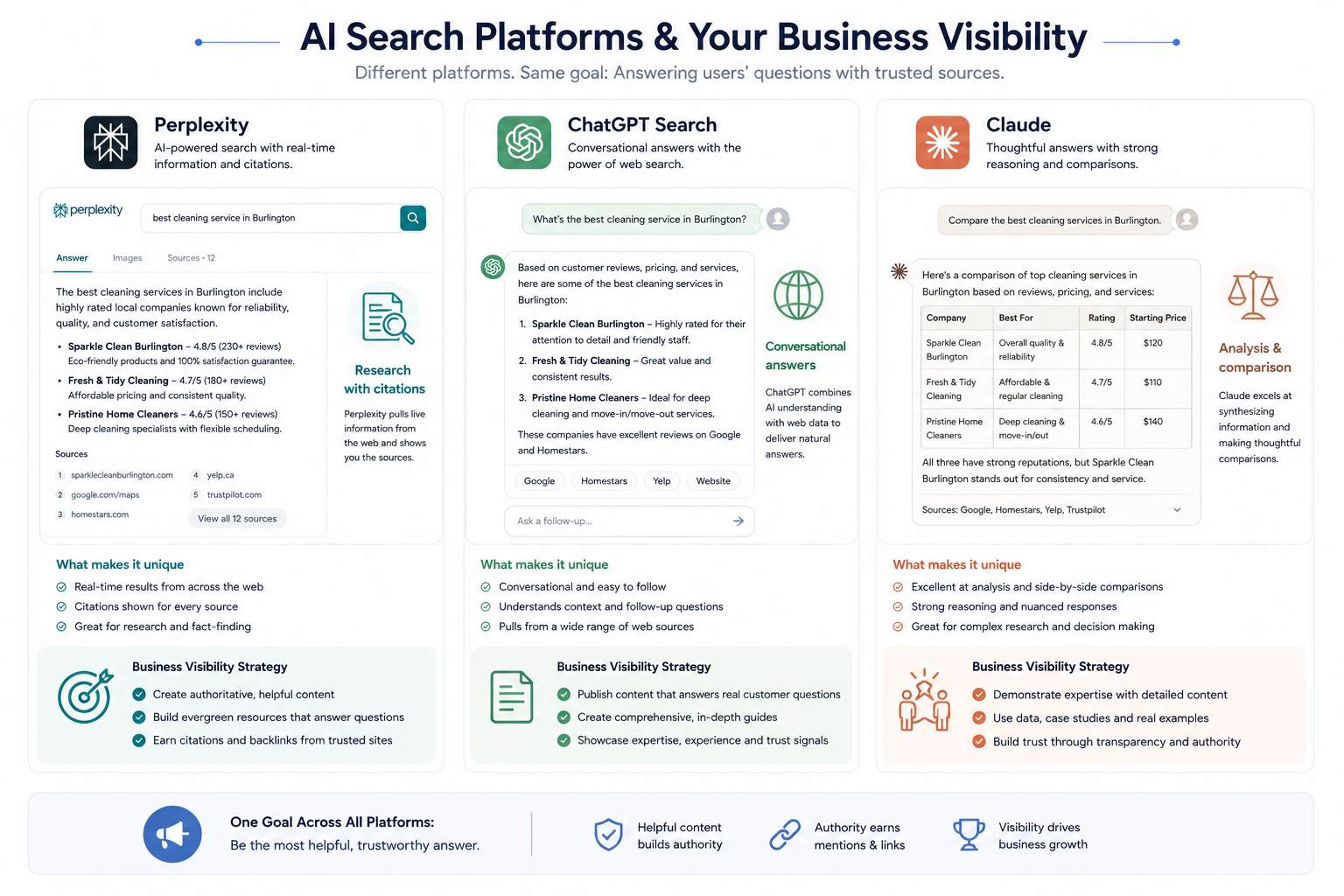
Generic advice about “optimizing for AI search” is not useful. Here is how each major platform actually works and what you can do about it.
Perplexity
Perplexity cites its sources visibly and links back to them, which makes it the most transparent AI search tool for businesses trying to build visibility. It tends to draw from authoritative web pages, established publications and sites with strong backlink profiles. To improve your chances of being cited:
- Publish content that directly answers specific questions in your area of expertize
- Use clear H2 and H3 headings that match the phrasing of questions your customers actually ask
- Build third-party mentions through guest posts, local media coverage and directory listings
- Ensure your website’s technical health is solid so Perplexity’s crawlers can index it cleanly
ChatGPT Search
ChatGPT’s browsing and search capabilities pull from live web content when enabled. The same content quality principles apply, but ChatGPT also draws from its training data, which means older, well-established web pages with strong authority carry weight. Focus on producing evergreen content on topics central to your business and ensuring that content is well-linked from other credible sources.
Claude
Claude is increasingly used for research and comparison tasks. When users ask Claude to help them choose between service providers or understand a product category, Claude synthesizes from sources it can access or from its training data. Getting your business into relevant industry directories, earning coverage from Canadian business media, and maintaining a clear “About” page with specific credentials and service details all help here.
Across all three platforms, the common thread is authority and clarity. Vague, keyword-stuffed content earns nothing in AI search. Specific, well-organized, credible content earns citations.
Real-World Scenarios: Small Businesses Already Winning With Dual-Channel Visibility
Consider a plumbing company in Etobicoke that produces a detailed blog post about the cost of replacing a hot water tank in Toronto, including permit requirements and typical timelines. That post earns a Google ranking for relevant local queries. It also gets cited in Perplexity when a homeowner asks what a hot water tank replacement costs. The same piece of content is doing double duty.
An Oakville-based accountant who publishes a clear breakdown of Canadian small business tax deadlines and CRA filing requirements finds that their content is being referenced in ChatGPT answers when users ask about tax planning for sole proprietors. Their Google traffic increases, and they start receiving calls from clients who found them through an AI-generated answer.
A Milton retail shop that ensures its Google Business Profile is complete and its website includes detailed product descriptions, clear return policies, and a local history section finds that AI tools citing local businesses in that category consistently pull from their site.
These are not extraordinary outcomes. They reflect what happens when a business produces genuinely useful content and maintains a technically sound web presence. The dual-channel benefit is a natural result of doing the fundamentals well.
Your Plan for If AI Searches Replace Google: 6-, 12-, and 24-Month Roadmap
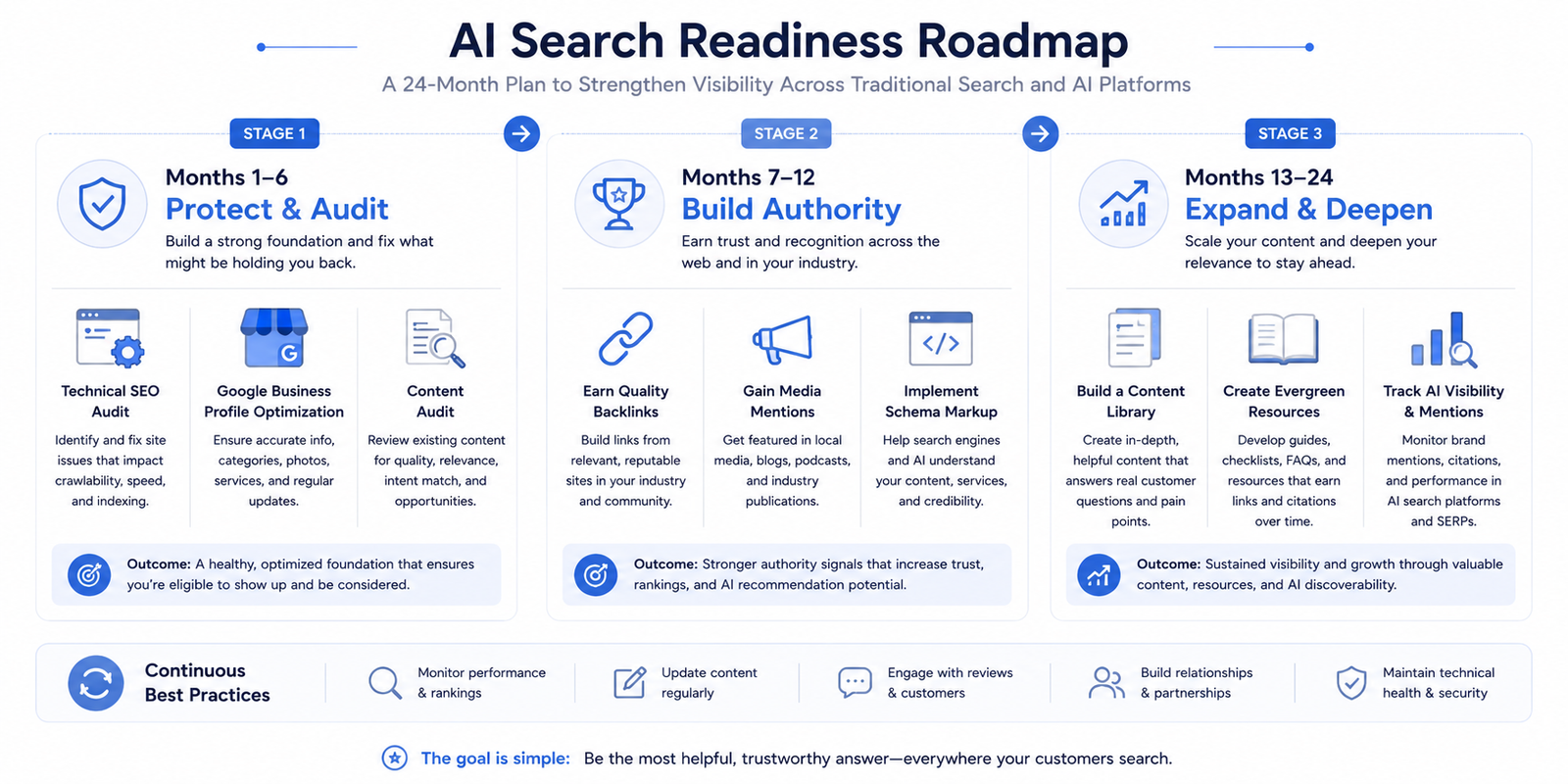
Months 1 to 6: Protect and Audit
- Conduct a technical SEO audit to identify and fix crawl errors, slow pages, and missing metadata
- Audit your Google Business Profile for completeness, accuracy, and recent reviews
- Identify your top five to ten most valuable pages and ensure they directly and thoroughly answer the questions your customers are searching for
- Begin a simple content calendar targeting informational queries in your industry (one to two posts per month is sufficient)
- Confirm your business is listed accurately in key Canadian directories: Canada411, Yellow Pages Canada, and any industry-specific directories relevant to your sector
Months 7 to 12: Build Authority
- Pursue two to four guest posts or media mentions on credible Canadian websites relevant to your industry
- Restructure existing service pages so they open with a direct answer to the customer’s core question, followed by supporting detail
- Add structured data (schema markup) to your key pages, including LocalBusiness, FAQ, and Service schemas
- Monitor which of your pages are being cited by AI tools by periodically asking Perplexity or ChatGPT questions relevant to your business and noting whether your site appears
Months 13 to 24: Diversify and Deepen
- Expand your content library to cover the full range of questions your customers ask at every stage of the buying process
- Build a simple resource or guide that other sites will reference and link to
- Review your AI search footprint quarterly and adjust content based on which topics are generating citations
- Evaluate whether paid visibility options on AI platforms become relevant for your business category as those products mature
These ranges assume a small business working with an agency partner on a monthly retainer or project basis. DIY approaches can reduce costs but typically require more time and produce slower results.
Where to Start This Week: Design Evolution’s First-Move Framework for Small Business Owners
The most useful thing you can do this week is get an honest picture of where your business currently stands across both channels.
Start by searching for your own business on Google and noting what appears. Then open Perplexity and ask it a question your ideal customer would ask when looking for a business like yours in your city. Note whether your business appears, and if not, which businesses do. That gap is your starting point.
Check your Google Business Profile for accuracy. Make sure your hours, address, phone number and website are current and consistent with what appears on your website and other directories.
Look at your most important web pages and ask honestly: does each page answer one clear question, thoroughly and specifically? If not, that is where your content investment should go first.
From there, the path forward is methodical rather than reactive. A small business SEO strategy built for 2026 and beyond requires strong foundations today, not a pivot away from Google, but a steady expansion into AI search platforms as they mature. The businesses that will be well-positioned in 2028 and beyond are the ones that build on strong SEO foundations now while gradually extending that authority into AI search platforms. Neither step requires panic. Both steps require consistency.
Not sure where your business stands in the AI search transition? Design Evolution offers a no-pressure visibility audit that maps your current Google rankings alongside your AI search footprint, so you know exactly what to protect, what to build and in what order. Book your free strategy call today and leave with a clear, prioritized action plan built for your budget and timeline.